DOT Non-Domiciled CDL Rule
Client AlertExecutive Summary
On February 13, 2026, the Federal Motor Carrier Safety Administration (FMCSA) published a final rule titled "Restoring Integrity to the Issuance of Non-Domiciled Commercial Driver's Licenses." Effective March 16, 2026, the rule sharply restricts which immigrants may hold a Commercial Driver’s License (CDL) or Commercial Learner’s Permit (CLP), limiting eligibility to holders of H-2A, H-2B, or E-2 visas only. Critically, the rule eliminates Employment Authorization Documents (EADs/work permits) as qualifying credentials — stripping CDL access from an estimated 194,000 drivers who are lawfully present and authorized to work in the United States. Active litigation is pending in the D.C. Circuit Court of Appeals.

1. Key Definitions: Domiciled vs. Non-Domiciled CDL
What Is a "Domiciled" CDL?
A standard (domiciled) CDL is issued by the U.S. state in which the driver permanently resides. U.S. citizens and lawful permanent residents (green card holders) who live in a U.S. state obtain domiciled CDLs. This rule does not affect domiciled CDL holders.
What Is a "Non-Domiciled" CDL?
A non-domiciled CDL is issued by a U.S. state to a driver whose permanent legal domicile (primary residence) is in another country or jurisdiction. This credential was specifically created for foreign nationals authorized to work in the United States in commercial driving roles, but who are not U.S. permanent residents.
In practice, this covers a wide range of legally present immigrants — from temporary visa holders to refugees who have built careers in trucking while living in the U.S. All 43 states that issue non-domiciled CDLs (all except NH, RI, WV, TN, AR, MS, and AL) are affected by this rule.
The Prior Standard
Before the rule, federal law required only that a non-domiciled CDL applicant present one of the following:
- An unexpired Employment Authorization Document (EAD), commonly called a "work permit"; or
- An unexpired foreign passport with an approved I-94 Arrival/Departure Record.
States had discretion over expiration dates and additional requirements. No restriction was placed on the type of immigration status held, only that the person was work-authorized.
2. What the New Rule Changes
The final rule makes the following key changes, effective March 16, 2026:
- Visa restriction: Only H-2A, H-2B, and E-2 visa holders are now eligible for non-domiciled CDLs. All other immigration categories — including those with valid EADs — are excluded.
- EADs eliminated: Employment Authorization Documents are no longer accepted as proof of CDL eligibility. This is the most consequential change, as EADs are the document issued to the largest categories of work-authorized immigrants.
- SAVE system mandatory: State DMVs must verify every applicant’s immigration status using the Systematic Alien Verification for Entitlements (SAVE) federal database.
- Expiration tied to I-94: The CDL’s validity cannot extend beyond the expiration date on the driver’s Form I-94 (or one year, whichever is sooner).
- In-person renewal required: All issuances, transfers, renewals, and upgrades must be completed in person.
- Document retention: State licensing agencies must retain copies of application documents for at least two years and must produce them to FMCSA within 48 hours of a request.
- Downgrade authority: If FMCSA, DHS, or another federal agency notifies a state that a driver’s immigration status has changed or lapsed, the state must downgrade or revoke the CDL within 30 days.
3. Who Loses CDL Access: Affected Populations
⚠ CRITICAL IMPACT: Lawfully Present Workers Losing CDL Access
The rule does not target undocumented individuals. The populations most affected are immigrants who are lawfully present in the United States, possess valid federal work authorization, have passed CDL testing requirements, and have been driving legally for years. These individuals will lose their CDL eligibility solely because their immigration category does not match the three approved visa types.
The following populations will lose the ability to obtain or renew a non-domiciled CDL under the final rule:
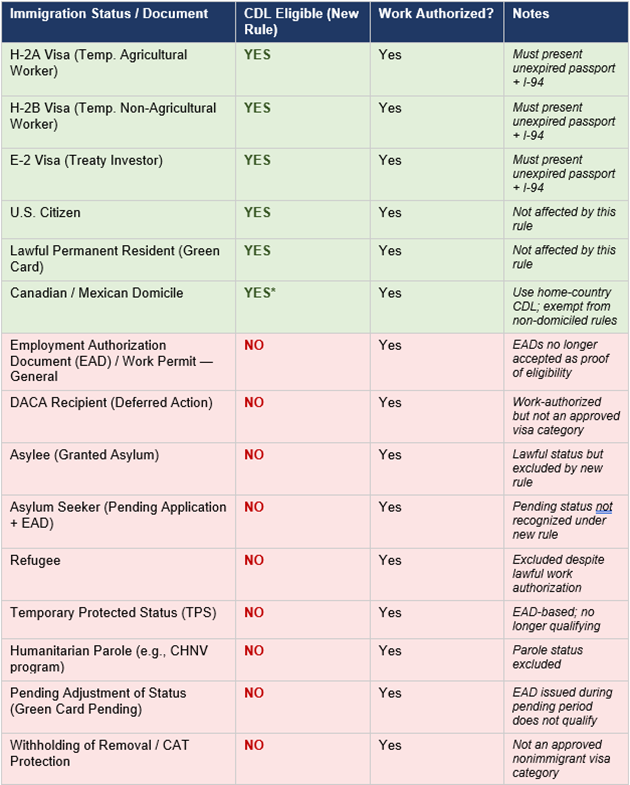
* Canadian and Mexican-domiciled drivers are separately exempt from the non-domiciled CDL framework because the U.S. recognizes commercial licenses from those countries under reciprocal agreements.
Scale of Impact
Approximately 194,000 currently employed commercial drivers are estimated to eventually lose their jobs as the rule takes effect and CDLs expire. Immigrants make up roughly 18% of the U.S. trucking workforce, an industry already facing severe labor shortages. The Sikh community in particular has been disproportionately affected, as commercial trucking is among the most common professions in that community.
4. The Government’s Stated Rationale
FMCSA framed the rule around two primary justifications:
- Safety concerns: FMCSA cited 17 fatal crashes in 2025 resulting in 30 deaths that involved non-domiciled CDL holders who would be ineligible under the new rule. The agency argued that domestic CDL holders are subject to national database checks for violations (DUIs, reckless driving, crash history) that cannot be replicated for foreign drivers.
- Regulatory non-compliance: Audits of state licensing agencies found widespread failure to ensure CDL expiration dates matched the driver’s authorized period of stay, with some drivers retaining CDLs beyond their lawful presence.
NOTE: FMCSA’s own data undermines the safety argument.
The D.C. Circuit noted in staying the earlier version of this rule that "FMCSA’s own data appears to indicate that the CDL holders excluded by the rule are involved in fatal crashes at a lower rate than CDL holders who are not excluded." Non-domiciled CDL holders represent approximately 5% of all CDL holders but only 0.2% of fatal crashes. FMCSA has itself acknowledged "insufficient data to quantifiably determine that non-domiciled CDL holders pose a disproportionate safety risk."
5. Pending Litigation
As of early March 2026, multiple active legal challenges are pending:
A. Rivera Lujan v. FMCSA — D.C. Circuit Court of Appeals (Lead Federal Case)
This is the most significant pending matter. Petitioners — including DACA recipient and owner-operator Jorge Rivera Lujan, represented by Public Citizen Litigation Group — have filed for an emergency stay of the March 16, 2026 effective date, arguing the rule is arbitrary and capricious and will cause irreparable harm.
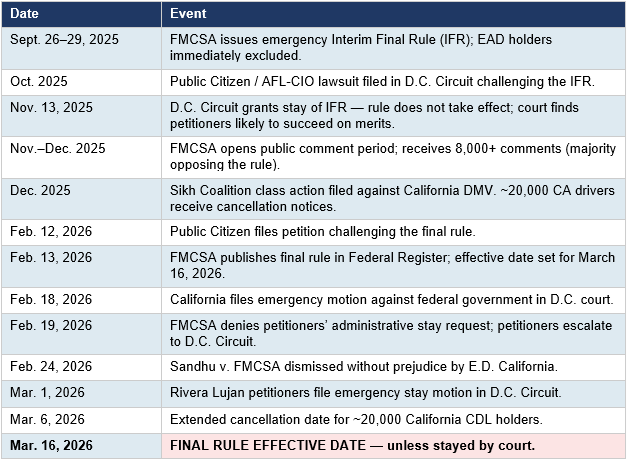
These same petitioners successfully obtained a stay of the September 2025 interim version of this rule. In that earlier ruling, the D.C. Circuit found petitioners were "likely to succeed" on their merits claim and flagged the crash data concerns noted above. FMCSA denied the petitioners’ administrative stay request on February 19, 2026, prompting the emergency filing. The court’s decision on the stay request is the most critical near-term development to monitor.
B. Public Citizen / AFL-CIO Lawsuit — D.C. Circuit
In October 2025, the Public Citizen Litigation Group, the American Federation of Teachers, and the American Federation of State, County and Municipal Employees filed suit against the interim rule. On February 12, 2026 — the day before the final rule was published — Public Citizen filed a new petition specifically challenging the final rule. This case proceeds in parallel with Rivera Lujan.
C. Sikh Coalition Class Action — California State Court
In December 2025, the Asian Law Caucus, Sikh Coalition, and Weil, Gotshal & Manges LLP filed a class action against the California DMV on behalf of approximately 20,000 drivers who received CDL cancellation notices. The California DMV extended cancellation dates, but the DOT responded by withholding approximately $160 million in federal highway funding from California.
A Bay Area judge in Alameda County Superior Court issued a tentative ruling that the 20,000 drivers should retain their licenses — but that outcome would place California out of federal compliance.
D. California Emergency Motion (State v. Federal Government)
California filed an emergency motion in federal court accusing the DOT of “moving the goal posts” and alleging the government “never intended” for California to reissue CDLs to eligible drivers. California contends the agency’s actions reflect “hostility to immigrant drivers and a desire to force them from the commercial market.
E. Sandhu v. FMCSA — Dismissed
An individual case filed in the Eastern District of California by refugee driver Jaswinder Pal Singh Sandhu was dismissed without prejudice on February 24, 2026 for failure to state a claim. This does not affect the other active cases.
6. Congressional Action
Supporters of the rule are moving to codify it legislatively to protect it from reversal by future courts or administrations. Rep. David Rouzer (R-NC) introduced H.R. 5688, the Non-Domiciled CDL Integrity Act, which would enshrine the rule’s restrictions in statute. The Owner-Operator Independent Drivers Association (OOIDA) has urged swift passage. Passage would significantly complicate any legal or administrative effort to reverse the restrictions.
7. Key Dates & Timeline
8. Practical Takeaways
For Employers / Motor Carriers
- Audit your driver roster immediately to identify any non-domiciled CDL holders and determine their visa category.
- Drivers with currently valid CDLs and valid work authorization may continue operating until their CDL expires — but cannot renew unless they hold an H-2A, H-2B, or E-2 visa.
- Begin workforce planning for potential departures; the rule, if it takes effect, will create significant driver shortages.
- Monitor the D.C. Circuit for a ruling on the emergency stay. If a stay is granted, the status quo is preserved pending further review.
For Affected Drivers
- If you hold an H-2A, H-2B, or E-2 visa: You remain eligible. Prepare your unexpired passport and I-94 for renewal.
- If you hold any other status (DACA, TPS, pending adjustment, asylee, refugee, parole, or general EAD): Consult an immigration attorney immediately. Your CDL cannot be renewed under the rule as currently written.
- Watch for court rulings — particularly from the D.C. Circuit — in the days leading up to March 16, 2026.
For guidance on how the FMCSA’s new non-domiciled CDL rule may impact your drivers or workforce, contact BMD member Rob Ratliff at raratliff@bmdllc.com.