Summer Associate Mentor Spotlight: Brianna Lubor
Blog PostInterviewed by Summer Associate Zoe Ting


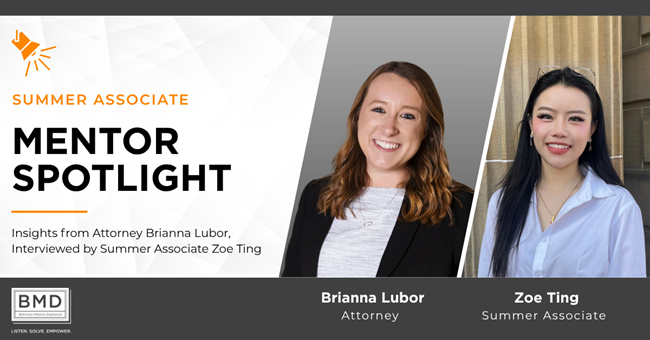
As part of our 2026 Summer Associate Program, Columbus Summer Associate Zoe Ting sat down with her mentor, Brianna Lubor, to learn more about her path into law, her experience at BMD, and her advice for young attorneys.
The Path to Commercial Litigation
Brianna knew she wanted to be an attorney as early as high school, and her initial interest was in criminal law. Although her practice now focuses on complex commercial litigation, her core motivation has remained the same: helping people and solving problems through the legal system.
During law school, Brianna’s favorite courses were Criminal Law, Civil Procedure II, and Federal Courts. Her strong academic performance led to her serving as an editor of the Ohio State Journal of Criminal Law. It was through her summer experiences and her time externing at the Supreme Court of Ohio that she realized commercial litigation was a better fit for her personality and interests.
Brianna first joined BMD as a law clerk during her 3L year, where she enjoyed the opportunity to work with colleagues across multiple offices. That experience ultimately led her to return to the firm as an associate after graduation to continue developing her practice in an area she found both engaging and fulfilling. Since joining the firm full-time, she has worked with Members and Partners across the Akron and Canton offices and now calls BMD’s Columbus office home as she enters her third year with the firm.
Brianna has remained involved in the firm's Summer Associate Program as a mentor and looks forward to continuing in that role. Having benefited from the support and guidance she received as a clerk, she values the opportunity to give back and help current Summer Associates navigate their own experiences at the firm.
Advice for Young Attorneys
When asked what advice she wishes she had received early in her career, Brianna emphasized the importance of developing strong interpersonal and professional skills. She noted that qualities such as being kind, collaborative, and communicative are often more difficult to teach than substantive legal knowledge.
She also noted that as legal skills develop over time, it is important to remain open to feedback and consistently strive to improve your work product. Putting in extra effort through attention to detail or additional research early on can help build credibility as a young attorney and set the foundation for long-term success.
What Makes a Great Summer or Junior Associate?
Brianna emphasized that strong communication is one of the most important qualities in a summer or junior associate. This includes asking thoughtful questions and acknowledging receipt of assignments to ensure expectations are clear.
She also highlighted the importance of being proactive in problem-solving. Rather than simply identifying issues, she encourages associates to come prepared with potential solutions to help move projects forward and demonstrate initiative.
Additionally, Brianna noted the value of being open to a wide range of experiences, including different practice areas, types of projects, and opportunities to connect with colleagues. Taking advantage of these opportunities helps build practical skills and develop a broader understanding of the firm and the legal profession.
Building Skills for Long-Term Success
Brianna shared that many of the most important skills for young lawyers overlap with those that make a strong summer or junior associate, particularly when it comes to communication and professionalism.
At the same time, she noted that there is always more to learn on the substantive side of the law, so approaching projects with a strong sense of accountability can make a meaningful difference in both day-to-day work and long-term professional development.
She highlighted that BMD is a great place to develop these skills, as it offers the opportunity to build relationships across the firm and fosters an environment that values both autonomy and accountability.