How to Spot Indicators of Financial Difficulty in Your Company's Suppliers and Vendors to Protect Your Interests
Client AlertBy: Matthew R. Duncan
In light of inflation, supply chain delays, and other negative signs in the current economic climate, it is important to recognize when companies with whom you do business, such as vendors or suppliers, may be experiencing financial difficulty and may be on the verge of seeking bankruptcy protection. You should discuss an action plan with your attorney if you see any of the following indicators that companies with whom you do business are in financial hardship.
- They are slow to fill orders. A pattern of untimely deliveries of orders may be a sign that your vendor/supplier is having cash flow problems and may be behind in paying its own suppliers or freight carriers.
- An abrupt change in their suppliers or freight carriers. If your vendor/suppliers suddenly changes its suppliers or freight carriers with which it has done business for quite some time, it could be a sign of financial difficulty. Be sure to ask your supplier/vendor why these changes have been made and investigate further if you do not receive a satisfactory answer.
- The vendor/supplier is slow to respond to inquiries concerning the status of orders or other matters or gives uncertain responses. Vendors/suppliers overwhelmed by calls from creditors tend to become more difficult for their customers to reach. If your vendor/supplier typically gives straightforward responses to your questions and its responses are now delayed or unclear, financial issues may be the cause.
- A number of important employees leave your vendor/supplier. If there begins to be significant turnover with your contact people at your vendor/supplier or if you learn that executive personnel such as officers or comptrollers have suddenly left the company, this can be a sign of financial difficulty regardless of whether the departures are voluntary.
- Requests by your vendor/supplier to shorten payment terms. If your vendor/supplier requests that your long-standing payment terms be shortened, it is a significant sign that they are having cash-flow problems.
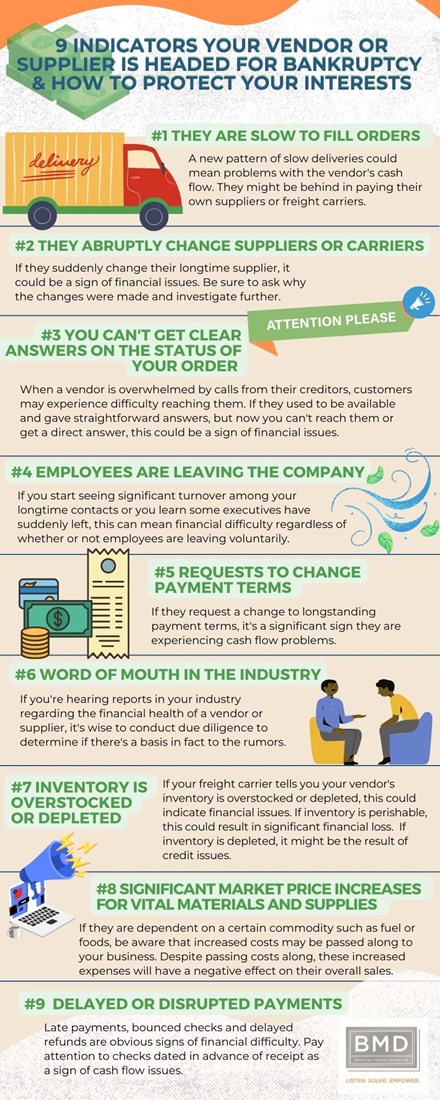
- Word of mouth in the industry. If you hear reports or rumors in your industry regarding the financial health of one of your vendors/suppliers, it is wise to do due diligence to see if these reports or rumors have a basis in fact. Ask your employees who deal with the vendor/supplier most often whether they have noticed any changes in the vendor/supplier’s procedures or quality of service. Also, raising these reports or rumors directly with your vendor/supplier benefits them if they can dispel them.
- Your vendor/supplier is overstocked with inventory or has depleted inventory. You may hear from freight carriers delivering product from your vendor/supplier that they are overstocked with inventory. If the goods being sold are highly perishable in nature, this could significantly undermine the vendor/supplier’s financial health. A significant depletion in your vendor/supplier’s inventory may be the result of credit issues.
- Significant market price increases for materials and supplies vital to your vendor/supplier’s business. If your vendor/supplier significantly relies upon a particular commodity, such as fuel or food ingredients, stay attuned to significant market price increases in these commodities. It is likely that your vendor/supplier will pass along some of these costs to you, but increased costs will almost certainly impact the vendor/supplier’s overall sales.
- Delayed or disrupted payments. Problems with timely payments are one of the more reliable signs of financial difficulty. Untimely payments, bounced checks, or delayed refunds are each obvious symptoms that the company with which you are doing business is in financial trouble. Take note of checks which may be dated well in advance of your receipt of them, as the delay in sending the checks may have been due to cash flow issues.
If a company with whom you do business is showing these signs of financial difficulty, contact your attorney to discuss strategies for protecting yourself from potential defaults. Attorney Matt Duncan is experienced in creditors’ rights and bankruptcy and would be happy to speak with you regarding your situation. Contact Matt Duncan at mrduncan@bmdllc.com.