Medicare Updates: Prior Authorizations and Physician Fee Schedule
Client Alert
UPDATE: The House Appropriations Committee (the Committee) met on September 9, 2025 to consider the Fiscal Year 2026 Labor, Health and Human Services, and Related Agencies Appropriations Act. The Committee adopted several amendments, including one introduced by Rep. Lois Frankel that blocks funding for the WISeR Model. She stated during the hearing that the pilot program would present “new roadblocks for seniors who depend on Medicare coverage.” As a result of the adopted amendment, WISeR is at a standstill. The amendment does not impact the proposed changes to the physician fee schedule set forth in the initial posting below.
Below please find two important updates for providers who participate in Medicare.
Medicare Prior Authorization Pilot Program in Six States
The Centers for Medicare & Medicaid Services (CMS) recently published its Wasteful and Inappropriate Service Reduction (WISeR) Model, which will be in effect from January 1, 2026, until December 31, 2031, for clinicians in six states (Arizona, New Jersey, Ohio, Oklahoma, Texas and Washington). In an effort to protect both Medicare beneficiaries and taxpayers from unnecessary services and fraudulent billing, WISeR will require prior authorization for 17 high-risk services that are especially susceptible to fraud and misuse. These services are listed in the chart below and include deep brain stimulation for Parkinson’s Disease, epidural steroid injections for pain management, cervical fusion, skin and tissue substitutes, and arthroscopy for knee osteoarthritis.

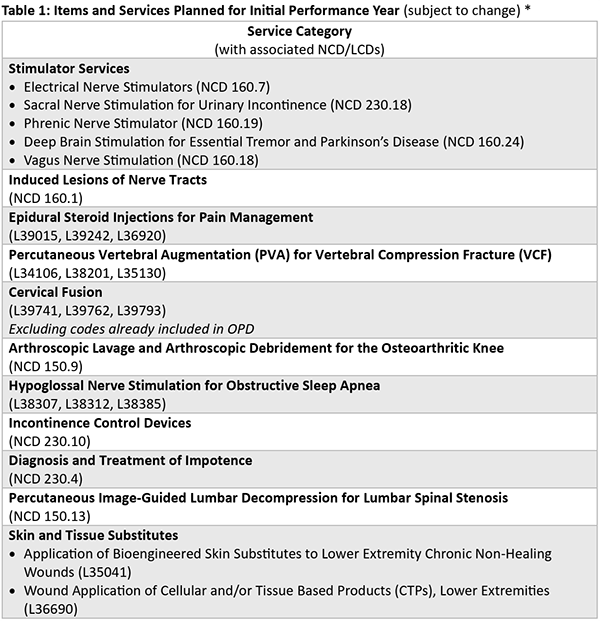
WISeR will apply to healthcare providers in Arizona, New Jersey, Ohio, Oklahoma, Texas and Washington. Clinicians in these pilot states have two options when they encounter these targeted services: 1) submit a prior authorization request or 2) face an automatic pre-payment medical review after the service has been provided. CMS will use technology, such as artificial intelligence to expedite the review process; however, the ultimate decision to deny a claim remains with a clinician. Note, that the WISeR model will only affect services and procedures covered by original Medicare (not Medicare Advantage plans), and will not apply to emergency care or inpatient-only procedures.
Proposed Updates to the Physician Fee Schedule
CMS will soon be considering comments to its proposed rule, CMS-1832-P, that includes changes to the physician fee schedule (PFS). CMS is proposing the following changes to the PFS, effective January 1, 2026:
- Payment Rate Calculation: CMS has paid for physicians’ services under the Medicare PFS since 1992. These payments are based on relative resources typically used to provide a particular service. Relative value units (RVUs) are applied to each service for work, practice expense, and malpractice expense. Payment rates are calculated through the use of RVUs and a conversion factor.
- Increased Conversion Factor:
- The calendar year (CY) 2026 qualifying APM conversion factor is estimated to be $33.59, a projected increase of $1.24 (+3.8%) from the current conversion factor of $32.35.
- The CY 2026 nonqualifying APM conversion factor is estimated to be $33.42, a projected increase of $1.07 (+3.3%) from the current conversion factor of $32.35.
- Efficiency Adjustment: To address the risk of overinflation in time assumptions built into the valuation of many PFS services, CMS seeks to apply an efficiency adjustment to the work RVU and corresponding interservice portion of physician time of non-time-based services that it expects to accrue gains in efficiency over time.
- Practice Expense: CMS does not intend to incorporate Physician Practice Information and Clinician Practice Information Survey data into PFS rate setting for CY 2026. However, it proposes to recognize greater indirect costs for practitioners in office-based settings. Additionally, CMS seeks to utilize data from auditable, routinely updated hospital data to set relative rates and inform its costs assumptions for some technical services paid under PFS. For CY 2026, CMS is proposing to use this data in setting rates for radiation treatment services and for some remote monitoring services.
- Telehealth Services:
- Streamline the process for adding services to the Medicare Telehealth Services List.
- Remove the distinction between provisional and permanent services.
- Permanently remove frequency limitations for subsequent inpatient visits, subsequent nursing facility visits, and critical care consultations.
- Permanently adopt a definition of “direct supervision” that allows a supervising practitioner to provide such supervision through real-time audio and visual interactive telecommunications (excludes audio-only).
- Authorize virtual direct supervision for applicable incident to-services under § 410.26, diagnostic tests under § 410.32, pulmonary rehabilitation services under § 410.47, cardiac rehabilitation and intensive cardiac rehabilitation services under § 410.49.
- Transition back to CMS’s pre-Public Health Emergency policy that requires teaching physicians to maintain a physical presence during critical portions of resident-furnished services to qualify for Medicare payment (for services provided within MSAs). Currently, teaching physicians may have a virtual presence through December 31, 2025.
- Global Surgery Payment Accuracy: CMS is soliciting public comment on how to improve the accuracy of payment for global surgical packages.
- Policies to Improve Care for Chronic Illness and Behavioral Health Needs:
- CMS is seeking feedback on how it can improve its support management regarding the prevention and management of chronic disease.
- Create optional add-one codes for Advanced Primary Care Management (APCM) services that would facilitate providing complementary behavioral health integration (BHI) or psychiatric Collaborative Care Model (CoCM) services.
- Expand payment policies for digital mental health treatment (DMHT) services to also make payment for devices used in the treatment of Attention Deficit Hyperactivity Disorder (ADHD).
- Skin Substitutes:
- Pay for skin substitute products as incident-to supplies when they are used as part of a covered application procedure paid under the PFS in certain settings.
- Align skin substitute categorization consistent with their FDA regulatory status.
- Drugs and Biological Products Paid Under Medicare Part B:
- New guidance regarding price concessions and bona fide service fees.
- Clarifies that units of selected drugs sold at the maximum fair price are included in the calculation of the manufacturer’s average sale price described in section 1847A(c) of the Social Security Act.
- Propose that preparatory procedures for tissue procurement required for manufacturing autologous cell-based immunotherapy be included in the payment itself.
- Rural Health Clinics (RHCs) and Federally Qualified Health Centers (FQHCs):
- Adopt optional add-on codes when RHCs and FQHCs are providing advanced primary care.
- Required reporting for individual codes that make up both CoCM and Communications Technology-Based Services (CTBS) and Remote Evaluation Services.
- Adopt services designated as care management services as care coordination services for separate payment for RHCs and FQHCs.
- Permanently adopt a definition of “direct supervision” that allows supervising practitioners to provide such supervision through real-time audio and visual interactive telecommunications (excludes audio-only).
- Policies to allow RHCs and FQHCs to bill for its services furnished using telecommunication technology by reporting HCPCS code G2025 on the claim for non-behavioral health visits.
- Medicare Prescription Drug Inflation Rebate Program: Proposing new policies including establishing a claims-based methodology to remove 340B units from Part D rebate calculations and creating a Medicare Part D Claims Data 340B Repository.
Additionally, CMS is seeking public input on how it can streamline regulations and reduce administrative burdens in Medicare.
To learn more about the new required prior authorizations and the proposed changes to the PFS, please contact BMD Vice President Amanda Waesch at alwaesch@bmdllc.com, Healthcare Member Daphne Kackloudis at dlkackloudis@bmdllc.com, Attorney Jordan Burdick at jaburdick@bmdllc.com, or Attorney Kate Crawford at khcrawford@bmdllc.com.